
Why Most Insurance Brokerages Are Struggling to Scale
Demand for exceptional insurance brokers is increasing, client expectations are rising, and more customer interactions are happening across multiple digital channels.
With the speed of AI, faster tools, and the need to use multiple platforms, insurance brokers are no longer facing a growth problem. Instead, the challenge for insurance brokers is handling the increasing demands of business operations while maintaining authentic client relationships.
On paper, everything in the business looks fine:
- Policies are being processed
- Renewals are being sent
- Clients are being serviced
But behind the scenes, teams might be overwhelmed by:
- Manual processes
- Disconnected systems
- Constant reactive work
The result of these disconnected systems is actually quite predictable. You see business growth stalling, more mistakes happening, and the experience of the client suffers.
For those insurance brokers who genuinely care about their clients’ experience, they are reviewing how their business can operate seamlessly with workflow automations
What Is Insurance Workflow Automation?
Insurance workflow automation is the process of designing, structuring, and automating the operational workflows that run your brokerage.
This includes:
- Renewal management
- Policy processing
- Client communication
- Compliance tracking
- Task allocation across teams
But automation alone isn’t enough.
The real goal is structured operations — where:
- Every process is defined
- Every task is triggered automatically
- Every team member knows exactly what happens next
Without this, automation simply speeds up broken processes.
Why Insurance Brokerages Are Falling Behind
The insurance industry has evolved rapidly with the advance of AI capabilities across all industries, but most brokerages haven’t changed or kept up with these changes.
Customer expectations are shifting toward:
- Faster, more accurate service
- Seamless digital experiences
- Personalised interactions
Yet most brokerages are still operating with:
- Legacy broking systems
- Spreadsheet-based tracking
- Email-driven workflows
This creates a growing gap between what the client expects and what brokerages can actually deliver.
The 3 Signs Your Brokerage Needs Workflow Automation
1. Growth Creates Chaos, Not Efficiency
In a well-structured business, growth should make things easier. In most brokerages, it does the opposite.
More clients lead to:
- More manual admin
- More follow-ups
- More room for error
Why? Because your workflows aren’t designed to scale.
What This Looks Like:
- Renewals tracked manually
- Staff relying on memory
- Tasks falling through the cracks
The Business Impact:
- Missed deadlines
- Increased compliance risk
- Senior staff stuck in admin
2. Your Systems Are Disconnected
Most brokerages operate across multiple tools:
- Broking platform
- CRM
- Spreadsheets
- Document storage
These systems rarely integrate properly.
What This Creates:
- Duplicate data entry
- Inconsistent client records
- No single source of truth
The Business Impact:
- Slow response times
- Poor visibility
- Inaccurate reporting
Your team ends up managing systems instead of managing clients.
3. Your Team Is Constantly Reacting
If your business runs on inboxes, you don’t have a system.
You have a reaction loop.
Most brokerages operate in:
- Last-minute renewal scrambles
- Manual follow-ups
- Firefighting mode
The Business Impact:
- Lost opportunities
- Burnout across the team
- Inconsistent service delivery
The Real Cost of Staying Reactive
Most brokerages don’t realise the cost of these inefficiencies because they’ve become normal.
But over time, they compound:
- Small delays turn into lost renewals
- Manual work limits how much the business can grow
- Inconsistent processes create compliance risk
- Teams spend more time managing work than delivering value
And ultimately, the business becomes harder to scale — not because of a lack of demand, but because the systems can’t support it.
What High-Performing Brokerages Do Differently
The brokerages that scale successfully don’t rely on more effort.
They rely on better systems.
They:
- Replace manual processes with structured workflows
- Centralise their data and operations
- Automate repeatable tasks
- Create visibility across the entire client lifecycle
This allows their teams to:
- Focus on clients, not admin
- Deliver consistent service
- Handle more volume without increasing workload
The Fortix Solution
This is exactly where Fortix comes in.
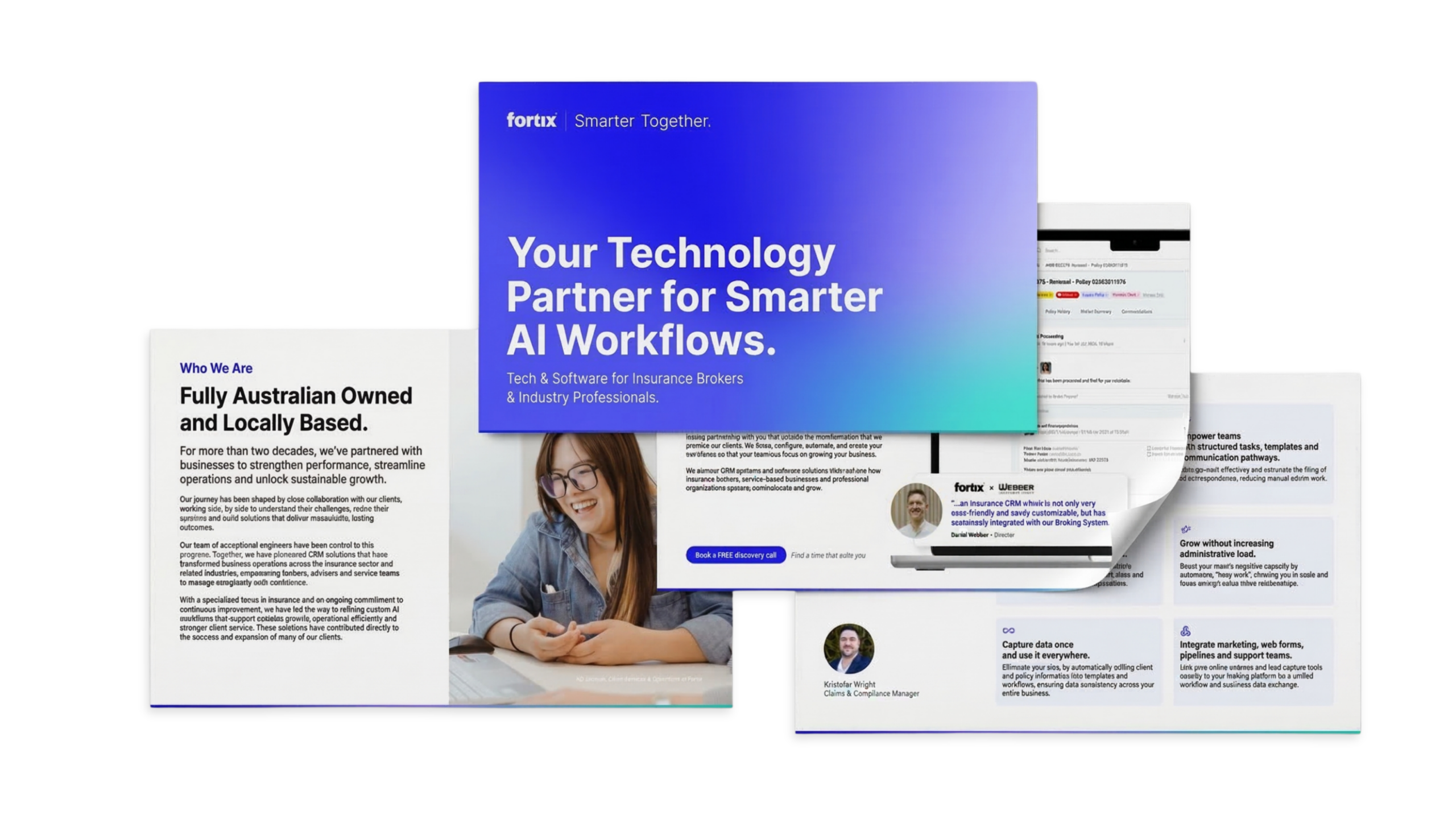
Fortix is built specifically for insurance brokers who need more than just a CRM — they need a complete operational system.
Instead of adding another tool into the mix, Fortix acts as the central layer that connects your brokerage:
- Your CRM
- Your workflows
- Your communication
- Your compliance processes
All working together in one structured system.
What This Looks Like in Practice
With Fortix, brokerages move from:
Manual → Automated
Tasks, reminders, and follow-ups are triggered automatically
Disconnected → Integrated
All client and policy data lives in one place
Reactive → Proactive
Workflows drive the business, not inboxes
Inconsistent → Structured
Every process is defined, repeatable, and scalable
The Outcome
When your workflows are structured and automated:
- Your team gains back hours every week
- Your clients experience faster, more consistent service
- Your business can scale without adding operational pressure
This is how brokerages move from working harder → operating smarter.
Take the Next Step
If any of this feels familiar, the next step isn’t to add more tools.
It’s to understand how your current workflows are actually operating.
Book a CRM & Workflow Walkthrough
If your brokerage is managing expansion and growth, Fortix can help you build the structure to scale with smarter AI workflows. Contact our Systems Specialist to see how you can grow your business today.
Talk to our systems specialist